Structural wood-destroying pests in the Sonoran Desert behave differently than standard perimeter insects. In suburban developments like Ocotillo, Fulton Ranch, and Andersen Springs, high-volume landscape irrigation…
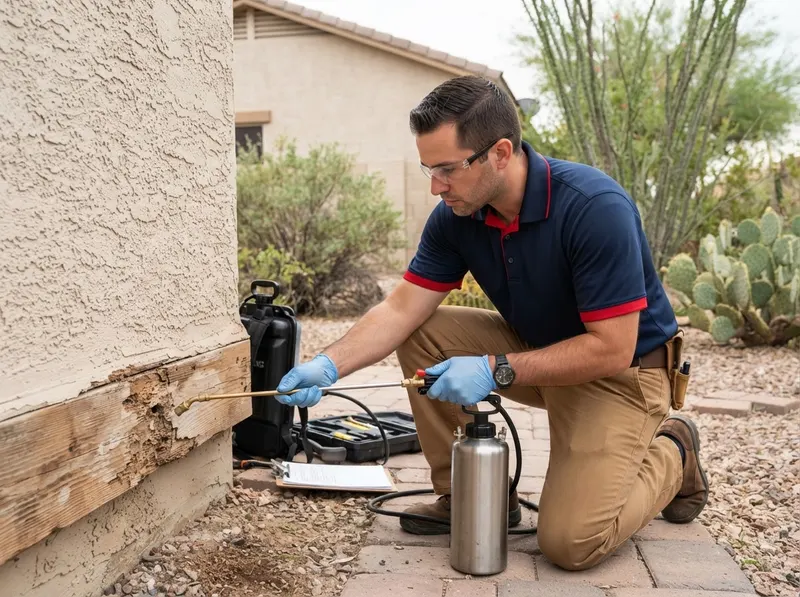
Structural wood-destroying pests in the Sonoran Desert behave differently than standard perimeter insects. In suburban developments like Ocotillo, Fulton Ranch, and Andersen Springs, high-volume landscape irrigation systems run adjacent to exterior stem walls, generating elevated moisture levels that draw carpenter ants into lower plate framing and window sill assemblies. Unlike subterranean termites that ingest cellulose, carpenter ants excavate clean, polished galleries within wood fibers to rear broods, ejecting fine, wood-shavings frass through microscopic clearance slits. Meanwhile, desert wood-boring buprestid and cerambycid beetles emerge directly from unseasoned architectural vigas, dead citrus limbs, and mesquite shade ramadas, leaving circular exit holes ranging from 1/8 to 1/4 inch across. Desert wood-borer activity frequently accelerates inside mature master bedroom additions and garage workshops throughout Warner Ranch and Galveston, where plumbing wall leaks or shaded foundation margins create optimal microclimates.
Controlling these wood-boring populations requires methodical detection rather than baseboard aerosol spraying. Standard broad-spectrum insecticides fail because they simply disperse foraging workers while the egg-laying queen remains protected inside hidden framing pockets. Step one involves deploying non-destructive acoustic sensors and surface moisture meters to locate active gallery networks behind drywall, stucco weep screeds, and roof fascia boards. Step two utilizes precision void injections of non-repellent transfer chemistry directly into verified structural chambers, allowing workers to carry the active ingredient into the core colony. Step three establishes an exterior defensive zone by sealing exterior weep holes with galvanized metal mesh, repairing broken expansion joints, and cutting back tree branches that bridge perimeter soffits.
Deciding between targeted void injection and a whole-structure perimeter defense depends on the distribution of frass and exit ports across the property. If structural inspection reveals exit holes localized strictly to one decorative beam or firewood cache near Fox Crossing or Pecan Grove, localized precision drill-and-inject treatment provides sufficient colony elimination without broad disruption. If acoustic probes register multiple internal nesting sounds across separate structural walls in homes near Sun Groves or Cooper Commons, selecting a complete structural treatment with exterior liquid barrier integration is necessary to prevent satellite colonies from establishing secondary nests. The operational trade-off centers on upfront service depth versus structural security: localized injection reduces immediate site prep, whereas whole-structure barrier defense requires systematic access to attics and crawlspaces to secure the entire framing envelope against Maricopa County pest cycles.
Every job gets a firm, written price after a free on-site visit.
Tell us about your carpenter ant & desert wood-borer infestation control job in Chandler and we'll send a clear, written quote, usually the same day.
 Iron Mesa Pest Control